
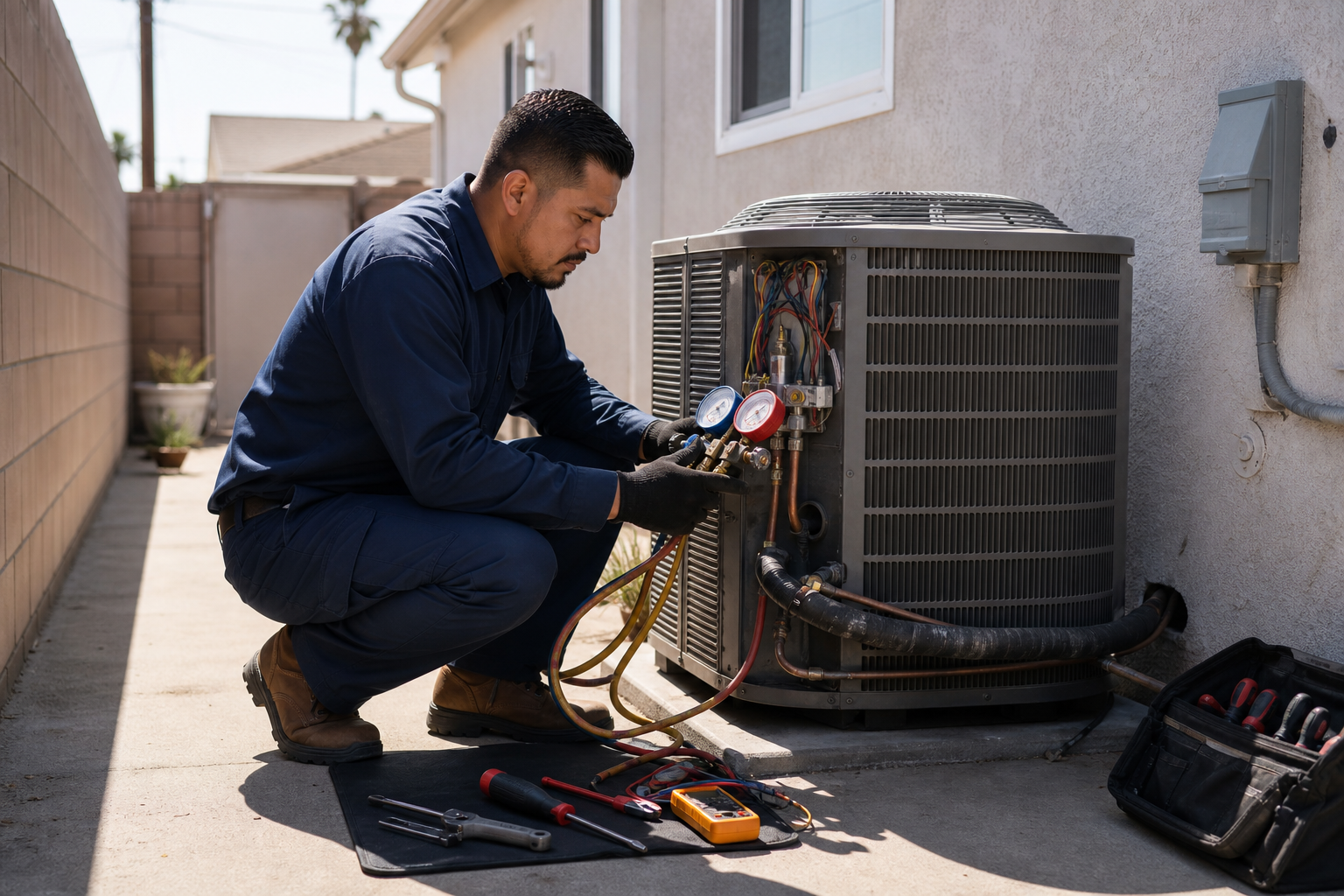
Why the installation quote should ask more questions than it answers
A good installation quote in Gardena starts with questions, not with a price. The questions sound technical but they protect the homeowner: what is the make and model of what is being replaced, what is the panel size and main breaker rating, what is the supply pipe size or duct configuration, where is the equipment going to live, what is the conduit or vent route, and what is the inspection authority for this address. A quote that skips those questions and just lists a flat number for AC installation is selling a guess.
Gardena adds a few specific questions. The cluster context — Harbor and South Bay Edge — and the building stock in this part of the city change which assumptions are safe. Postwar tract homes have different access realities than newer townhomes. Garage panels have different capacity profiles than meter-main combos. Long Beach addresses have different permit paths than LA County addresses. The right installer asks those questions before printing a number, then writes the answers into the quote.
Harbor and South Bay Edge cluster context: The Harbor and South Bay Edge cluster lives between the freeway, the rail corridor, and the older industrial fringes. Homes here see more particulate load on HVAC equipment, more demand on older 100-amp panels as residents add modern appliances, and more drain-line pressure from clay and galvanized infrastructure that predates current code.
Quick answer for Gardena homeowners
AC Installation in Gardena should start with a clear symptom, a clean access plan, and a realistic view of what can expand the scope. The visible problem may be wrong equipment match, old ducts wasting capacity, undersized electrical service, but the visit can change when the property adds side-yard condenser access, panel photos, or cleanouts. In a small apartments, the technician may need to reach the equipment, panel, drain, shutoff, cleanout, garage, side yard, attic, crawl space, or utility location before the real diagnostic work starts.
The most useful preparation is simple: use the external booking link, add photos, list the exact symptom, note whether another fixture or appliance is affected, and confirm who controls shutoffs or utility areas. If the call involves no cooling, active leaking, gas odor, burning smell, repeated breaker trips, water heater failure, or a backup that affects more than one fixture, treat it as urgent. If the symptom is stable, use the same process to plan a repair, replacement, or inspection-ready estimate without forcing an emergency premium.
Best first move
Book through the external form, then prepare these items: Photograph old equipment labels; Confirm condenser location; Ask about duct leakage; Review panel capacity; Keep access clear for removal and replacement. For Gardena, add access notes for driveway staging; side-yard condenser access; panel photos; cleanouts; tenant windows.
Why AC installation is different in Gardena
Gardena editorial note: Gardena pages should bridge South Bay and Gateway Cities without becoming coastal luxury.
Gardena sits in the Harbor and South Bay Edge service cluster and is best understood as a South Bay edge city with tract homes, apartments, and freeway corridors. Homes around Western Avenue, Artesia Boulevard, 110 and 405 corridors can combine postwar homes, small apartments, duplexes, garage panels, slab homes on the same few blocks. That mix matters because the same AC installation call can require different equipment, ladder access, shutoff windows, garage or side-yard clearance, tenant scheduling, old-panel review, or cleanup protection depending on the property. A postwar tract home may have a slab foundation and old ducts. A small rental may have limited panel labeling and high plumbing use. A compact lot may hide old pipes, old wiring, or nonstandard mechanical routing behind newer finishes.
The local utility context is also part of the plan: Southern California Edison electric service is typical, with SoCalGas context for gas furnaces, water heaters, dryers, ranges, and gas line safety. The permit and inspection context is local city building department or LA County Building and Safety depending on address, with mechanical, electrical, plumbing, and sewer scopes verified before work. For ac installation, the permit question is: AC installation or replacement may require mechanical permit review, matched equipment documentation, electrical disconnect review, and inspection depending on the city and final scope. That does not mean every small diagnostic requires a major permit process. It means the repair should be separated from permanent replacement, new circuit work, gas or venting changes, sewer or pipe work, equipment relocation, or any scope that changes the building system.
Gardena data-point snapshot
Reference points: Western Avenue; Artesia Boulevard; 110 and 405 corridors. Building mix: postwar homes; small apartments; duplexes; garage panels; slab homes. Access profile: driveway staging; side-yard condenser access; panel photos; cleanouts; tenant windows. Risk profile: old panels; duct leakage; slab leaks; sewer roots; water heater failures. Seasonal operating context: marine influence; freeway dust; hot inland afternoons. Nearby comparison markets for routing and internal links: Carson, Compton, Willowbrook, Rancho Dominguez, Long Beach.
AC replacement field lens
AC installation pages should focus on matched equipment, duct leakage, condenser placement, noise clearance, electrical disconnects, and whether replacement solves the actual comfort problem. In Gardena, that lens is filtered through side-yard condenser access, panel photos, small apartments, and duct leakage. This is the reason the page does not treat ac installation as a city-name swap: the service decision changes when the home, access, utility, and failure mode change.
The best job note includes old model labels, furnace or air-handler location, duct condition, panel photos, condenser pad location, and any rooms that never cool well. The weak shortcut is selling tonnage before checking ducts, return air, line-set route, panel condition, and city inspection expectations.
- load and equipment match checked against old panels and driveway staging
- duct leakage and return sizing checked against duct leakage and side-yard condenser access
- condenser clearance and noise checked against slab leaks and panel photos
- line-set route checked against sewer roots and cleanouts
- disconnect and panel condition checked against water heater failures and tenant windows
AC Installation proof pack for Gardena
Gardena needs extra South Bay edge context because marine influence, freeway dust, slab leaks, and older garage panels often overlap. AC installation pages deserve extra detail because replacement decisions depend on matched equipment, ducts, line-set route, condenser placement, panel capacity, and inspection readiness.
old equipment labels, condenser pad, furnace or air-handler location, return-air size, duct condition, and electrical disconnect.
For Gardena, the quote should explicitly account for postwar homes, driveway staging, and old panels.
selling tonnage before checking duct leakage, return air, line-set route, condenser clearance, disconnect condition, and permit path.
This is a site-readiness and evidence note, not a claim that a specific completed customer job happened at this address.
- Photo target: old condenser label
- Photo target: air handler or furnace label
- Photo target: return grille and filter
- Photo target: side-yard condenser location
- Photo target: disconnect box
A useful Gardena dispatch note should sound different from a nearby-market note. For this page, the important local signals are Western Avenue, postwar homes, driveway staging, old panels, and marine influence. Those details change how ac installation is quoted, staged, diagnosed, and explained. They also help the visit avoid the common failure pattern where the technician arrives with the right trade skill but the wrong access assumptions.
From the truck — AC installation field journal
AC replacement in this market starts with a Manual J load calculation, not a rule-of-thumb tonnage match. Older tract homes were often oversized for cooling because nobody worried about humidity in coastal Southern California, but the duct system was sized for that oversized equipment. New high-SEER equipment runs longer and slower, which means the duct sizing matters more, the return air sizing matters more, and the thermostat staging matters more. The install crew brings line set, condenser pad, vibration isolators, and inspection-ready disconnect hardware on every job.
Real call from the field
Bell Gardens postwar home, replacing a 22-year-old 3-ton system. Original duct trunk was R4 in a hot attic and 18% leakage by duct blaster. We did Manual D, sealed and reinsulated the trunks (R8), replaced two register boots, then installed a 2.5-ton variable-speed system. House cools 4°F lower with 25% less runtime than the prior 3-ton fixed-stage equipment. Oversizing was the original problem.
The duct system is the AC system. New equipment on bad ducts is wasted money. I have walked away from quotes where the homeowner refused to address ductwork because I did not want my name on a system that would underperform.
Code, permit, and inspection context for AC installation
Code references that govern this work
- California Title 24 Part 6 (Building Energy Efficiency Standards) — load calc and HERS verification
- California Mechanical Code Chapter 3 — installation and clearances
- ACCA Manual J for residential load calculation
- ACCA Manual D for duct sizing if ducts are modified
Permit window
Permit required in every Gateway Cities jurisdiction for AC replacement. Title 24 also requires HERS verification for refrigerant charge, airflow, and (in some scopes) duct leakage. Typical inspection window is 5–15 business days after rough-in.
Typical visit duration
1 day for like-for-like replacement with clean duct interface; 2–3 days when ducts, line set, or pad work is added.
Inspection points we verify
- Manual J load calc on file
- Refrigerant line set sized to manufacturer spec for distance and elevation
- Disconnect type and amperage matches new equipment
- Condensate primary and secondary routing per CMC
- HERS technician scheduled for refrigerant charge verification
What is on the truck
matched evaporator coil, appropriate line set diameter, vibration isolators, rain-rated outdoor disconnect, secondary condensate float, new pad or composite stand.
Five questions to ask before approving AC installation work
The contractor's answers to these questions tell you whether the visit is going to be diagnostic-led or shortcut-led. There are no trick questions here — these are the questions a thoughtful tradesman is glad to be asked.
- Was a Manual J load calculation actually performed for my house, or was the size assumed from the old equipment?
- Is the duct system being measured and addressed, or assumed adequate?
- What is the SEER2 rating of the proposed equipment, and does it qualify for any rebate?
- Who pulls the permit and schedules HERS — the contractor, or am I responsible?
- What is the labor warranty separate from the manufacturer's parts warranty?
Common mistakes to avoid in Gardena
Most of these come from rushing diagnosis or quoting before measurement. They show up across Gardena on calls our techs end up cleaning up after another contractor.
- Assuming the existing tonnage is correct — most older homes are oversized, not undersized
- Replacing the condenser without addressing the coil match and ductwork
- Installing higher-SEER variable-speed equipment on leaky ducts and undersized returns — the new system underperforms the old one in real conditions
- Skipping HERS — it is required by Title 24 and the project will fail final inspection without it
Repair, replace, or inspection — decision criteria
Full replacement is responsible at 12–15 years for properly maintained equipment, sooner if the equipment uses R-22, the compressor has failed once, or the coil is leaking. Repair is still correct when the existing equipment is under 10 years, the duct system is adequate, and the failure is a single isolated component.
How ac installation is sequenced step by step
This sequence is what a properly run ac installation project looks like — written for the homeowner who wants to know what should be happening and when.
- Manual J load calculation. Calculate the actual cooling load for the home using ACCA Manual J — measure each conditioned room, account for insulation, window orientation, and infiltration. Resist matching the size of the existing equipment.
- Duct system audit. Measure static pressure, look for collapsed sections in the attic, and note return-air sizing. Address duct leakage before installing higher-efficiency equipment that depends on proper airflow.
- Permit and HERS scheduling. Pull the mechanical permit with the local building department or LA County. Schedule the HERS technician for refrigerant charge and airflow verification at the appropriate point in the project.
- Equipment removal and pad prep. De-energize the old condenser at the disconnect, recover refrigerant per EPA Section 608, remove the old equipment, prepare the pad or composite stand, and confirm clearances on all sides.
- Line set, electrical, and condensate. Install or refit the line set sized to the new equipment specs, verify the electrical disconnect amp rating matches the new equipment, and route condensate to a proper drain with a primary line and a secondary float switch.
- Equipment install and commissioning. Set the condenser, connect refrigerant lines and electrical, charge the system to manufacturer spec, and run through the commissioning checklist with measurements logged.
- HERS verification and final inspection. Schedule the HERS technician to verify refrigerant charge and airflow per Title 24. Schedule the final inspection with the building department.
Common failure modes and hidden risks
For this service, the common technical risks include wrong equipment match, old ducts wasting capacity, undersized electrical service, bad condensate routing, noise or clearance problems. In Gardena, local risks such as old panels, duct leakage, slab leaks, sewer roots, water heater failures can make those symptoms more expensive or more urgent. A cooling failure may be caused by a small part, but condenser condition, airflow restrictions, dusty coils, or electrical disconnect problems can change the visit. A panel or EV charger issue may look like one circuit, but load calculations, utility coordination, or old grounding can decide whether the work is safe. A plumbing leak may look contained, but water can move under slabs, behind cabinets, through walls, and toward electrical areas faster than most owners expect.
Do not keep resetting breakers, running water into a backed-up drain, using a leaking water heater, or operating HVAC equipment that smells hot or is spilling water. Those actions can turn a repair into broader home damage. The safer path is to isolate what you can, document the symptom, protect nearby areas, and book a visit with complete access notes.